
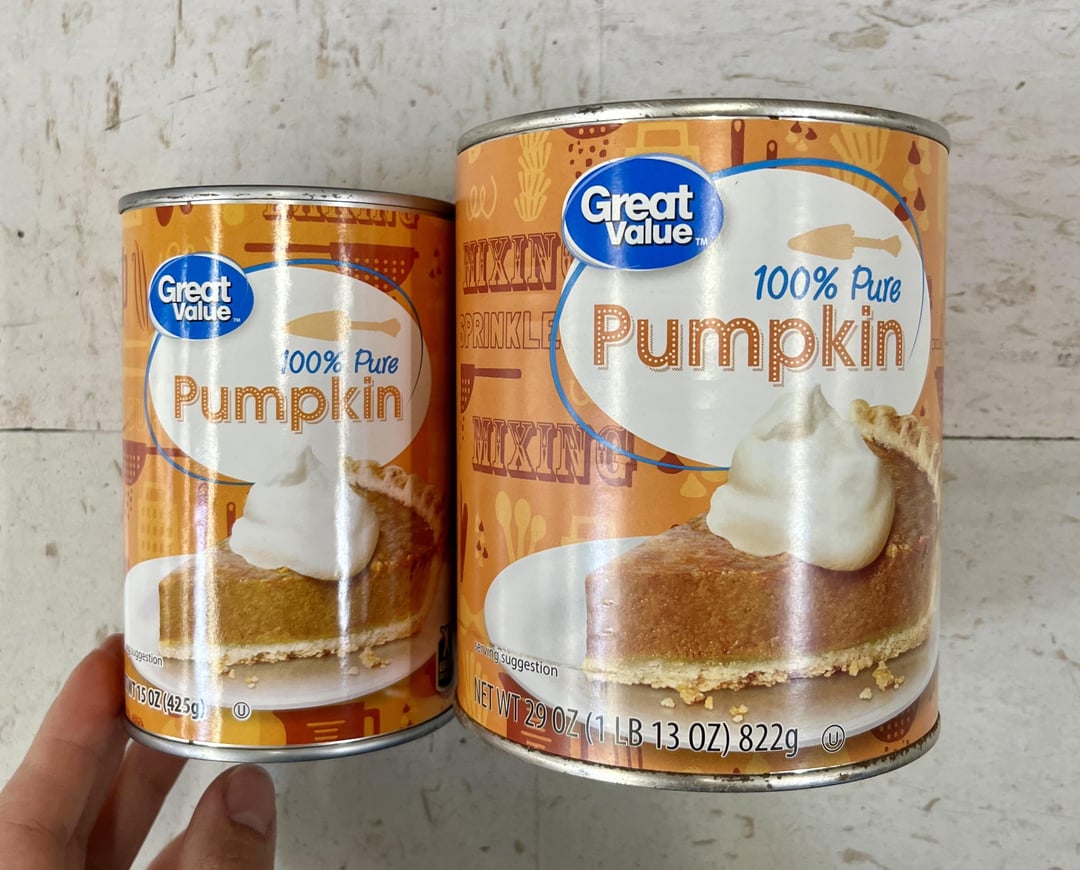
Can someone help me understand how the same product with same ingredients and same manufacturer has different caloric value? Am I missing something? I obviously bought the one with lower listed calories but know the only one I’m fooling is myself 🫣
by twoboobsandaface
28 Comments
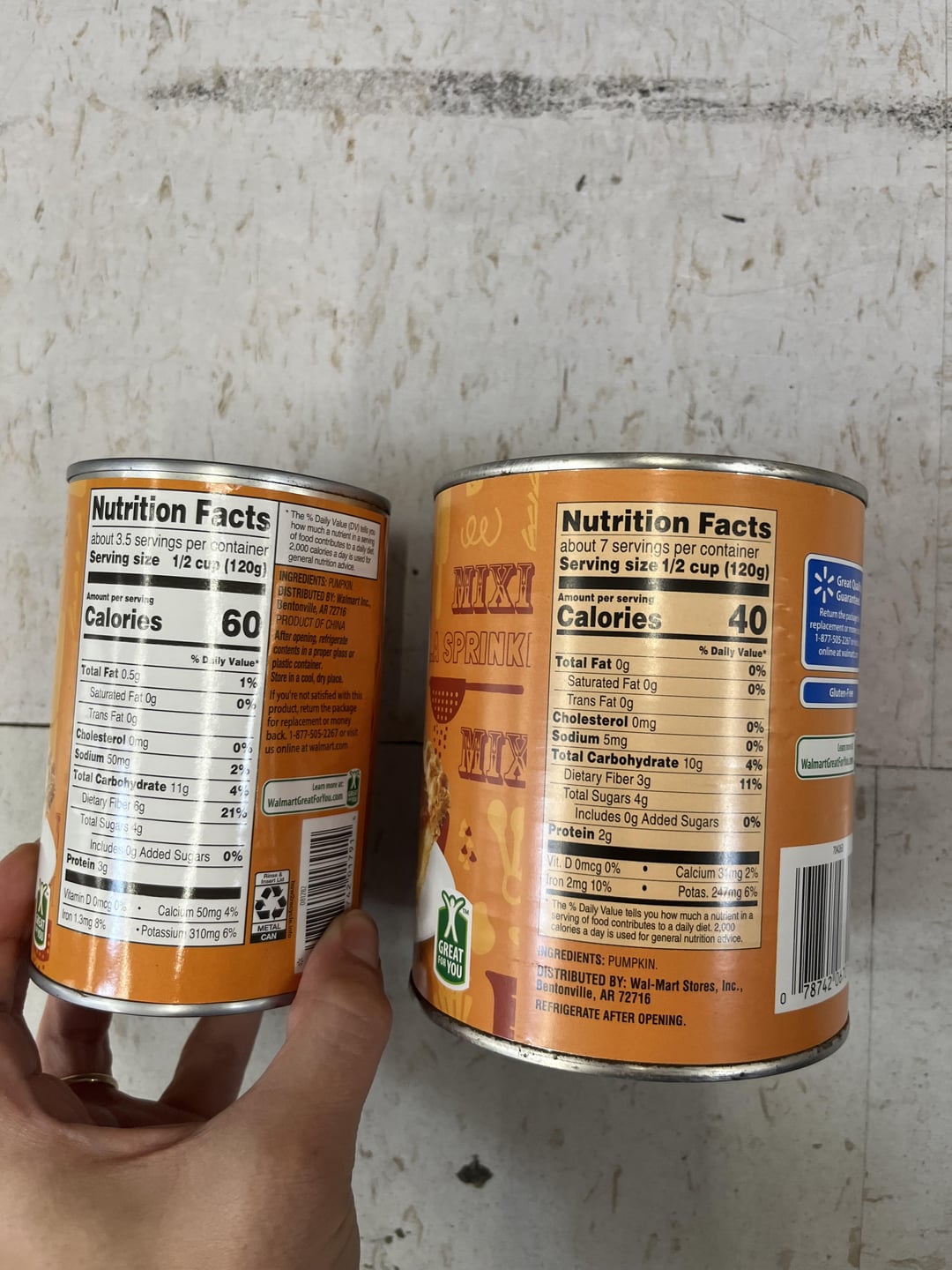
They’re not equal, the one on the left has 0.5g of PUFA/MUFA’s (healthy fatty acids poly/mono unsaturated). Alongside 45mg more sodium, 1g more protein and 1g more carbs per 120g
I would have always assumed two cans labelled this similarly would have the same exact product in it. One having 10x as much sodium per serving is kinda crazy
please don’t worry about it, it’s only a 20 calorie difference. Nutrition labels are not 100% accurate, they are allowed a little wiggle room
i assume it is different kinds of pumpkins. i know the stereotypical pumpkin we think of doesnt puree well and so they often use a different type. since great value doesnt actually manufacture their own products maybe one person does one can size and someone else another. seed patents is a strange world- so its possible they are using their own special strain of pumpkin. much to think about lol
I am seeing a difference of 1 g of protein on the label. That difference of ingredient would affect calories.
It’s the fat in the pumpkin, pretty sure it’s added
Interestingly, the smaller can notes “Product of China” and the larger one does not. Probably two different manufacturing plants…
Maybe a different variety that only some of Walmart’s manufacturers use? The website has the same nutrition facts for both sizes. I found some other brands, Sonatural 100% pumpkin, Pampa 100% pure, and MW Polar. These all have similar nutrition facts to your can and also all say product of China. They might all be from the same manufacturer who uses a different variety or something.
One is slightly more condensed than the other due to different manufacturing?
Different pumpkins being used. Over a hundred varieties of pumpkins and each had its own nutritional makeup. The pumpkins you carve don’t make great eating and are usually bred to have less “meat” in them. Even with eating pumpkins the varieties vary. My aunt used to grow a few acres of pumpkin every year with a huge variety. She would usually put in 3-4 different pie varieties too for me to bake with.
I noticed the same thing comparing a can from last year and a can from this year! Very strange.
One is from fat pumpkins.
FDA also allows a 20% margin of error for calories and other nutrients. So if they are on opposite ends .. 😅 nah I’m sure they probably just different pumpkins haha
there are different third party people who are hired to get the nutritions from food items as well as different kinds of pumpkins and sizes and ripe-ness which also changes the nutritional value
>Am I missing something?
per half a cup, 120g of can content.
>total fat .5g
vs
>total fat 0g
,
>sodium 50mg
vs
>sodium 5mg
,
>dietary fiber 6g
vs
>dietary fiber 3g
,
>protein 3g
vs
>protein 2g
,
> calcium 50mg iron 1.3mg and potassium 310mg
vs
> calcium 31mg iron 2mg and potassium 247mg
ingredients: pumpkin is pretty vague, different batches/harvests of pumpkin or different kinds of pumpkin seems to have different nutritional info
The one on the left has more protein, fiber, and sodium. The formula has changed.
Because they’re the not the same product. Concentrations are a factor, genetics are a factor, and nutrition at farm is a factor.
i dont have an answer for you but i would just meet in the middle and call an equal serving 50 calories lol sometimes it isnt worth thinking about it that hard but i understand the frustration
Nutritional labels are a guide, not exact.
On another note, why are these on the floor 😭 that’s very unsanitary for the next unsuspecting person who picks it up to buy
The nutrition is slightly different for the 60 calorie one. It adds up.
prob diff pumpkin types. the one on the left lists higher carbs, fats, and proteins which ultimately changes the caloric value
Could be that when they purée the pumpkins they strain a lot of the water out of it. Perhaps the lower calorie version just has a higher water content and the higher calorie one is more dense.
Different pumpkin varieties?
It might be water.
I just read that according to US regulations, water does not have to be in the ingredients list, if it is a normal part of the pumpkin and also not if it has been added to achieve a certain consistency.
I don’t actually know how it works in US, but in Europe companies have a margin of ~25% on thr precision of nutritional informations. Can be due to this maybe.
In the US I believe you are allowed to put squash in a can and call it pumpkin even if it’s something like summer squash or acorn squash or whatever. Probably not the case with the can made in China, so you’d be seeing two different plants in the cans.
3g of protein vs 2 and 11g of carbs vs 10